
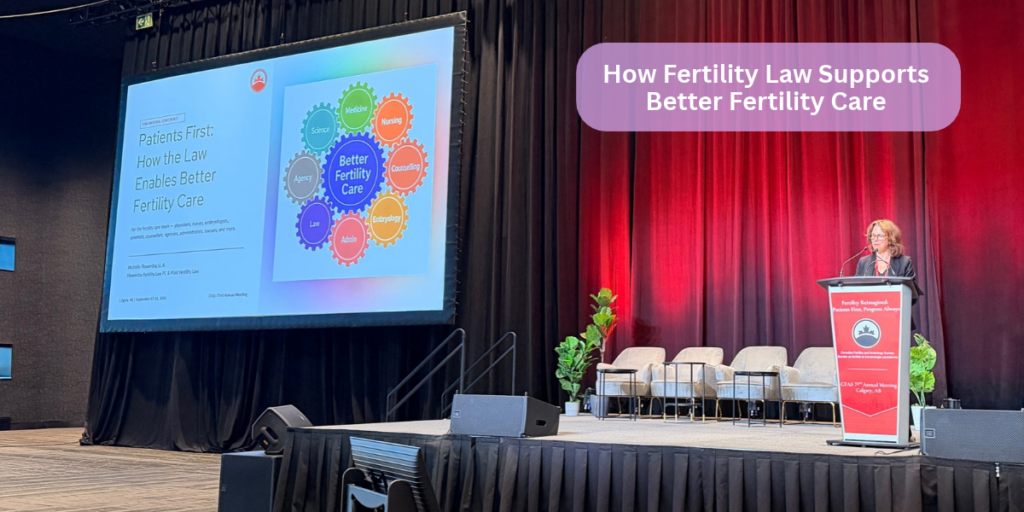
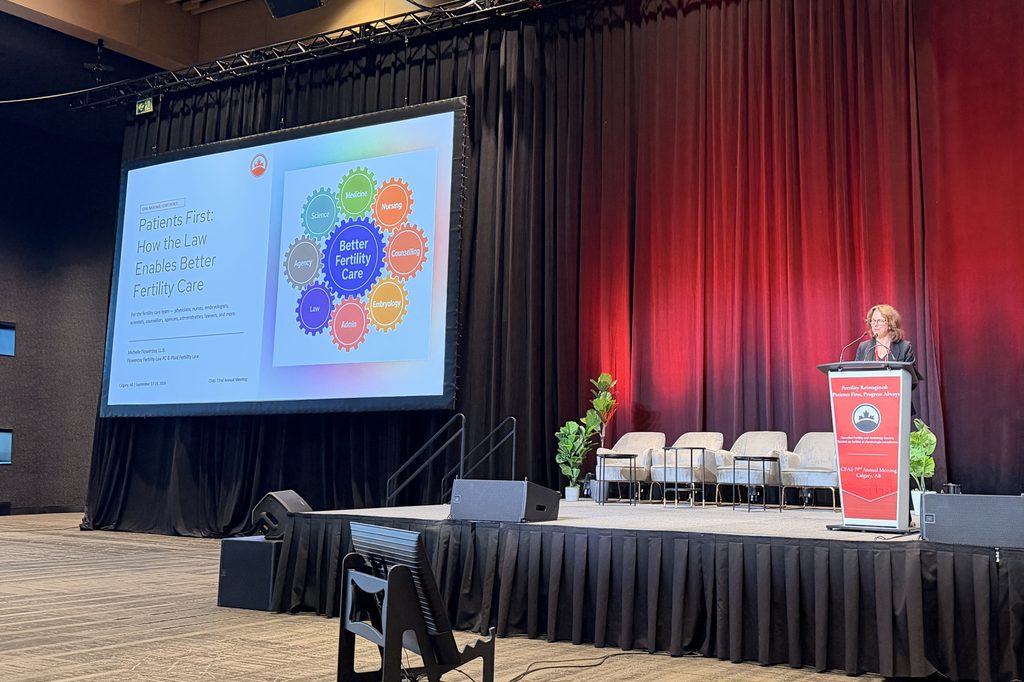
In September 2026, I was honoured to speak on the main stage at the Canadian Fertility and Andrology Society’s 72nd annual conference in Calgary. My presentation, Patients First: How the Law Enables Better Fertility Care, centred on a simple idea: better fertility care happens when every member of the team contributes their expertise while understanding how their role connects with the work of others.
As professionals, we each approach fertility care through the lens of our own work, but patients do not experience their fertility journey in silos. They experience it as one continuous, sometimes very long, path towards building a family. A discussion with a counsellor may raise legal questions. A decision in the embryology lab may affect future reproductive options. Patients need us to recognize those connections and work together around their care.
The legal framework is one of those critical connections. When understood and considered at the right time, it supports informed decisions and helps patients navigate uncertainty.
My talk explored five goals for better fertility care, the legal framework behind each one, and what each looks like in practice.
Key Takeaways
- Informed consent: Consent is more than a signature. Teams should pause when a patient or donor may not feel free to decide.
- Embryo planning: Embryo creation is a key legal decision point. Patients should consider the possibility of a future separation and the implications on future use of embryos before eggs or sperm are committed.
- Surrogacy and donor agreements: Working through an agreement, with independent legal advice, surfaces different expectations before treatment begins.
- Legal parentage: Parentage is governed by provincial law in Canada, so legal advice before conception matters, including for an unexpected birth in another province.
- Donor conception: Clear consent and record-keeping help families prepare for questions a donor-conceived child may ask years later.
1. Informed Consent in Fertility Treatment: Supporting Voluntary Decisions
The Law of Informed Consent in Fertility Care
Patients need to understand the decisions they are making and feel free to make them. The law of informed consent supports this goal through requirements for meaningful disclosure, understanding, and voluntariness.
Providing information is only part of the process. We also need to consider whether the person appreciates how that information applies to their circumstances and whether they feel able to decline.
Case Example: When an Egg Donor Feels She Has No Choice
Consider a woman preparing to donate eggs to her brother and his husband. During counselling, she explains that she has no choice because her family believes this is the best option for creating embryos.
She may understand the procedure. She may love her brother and want to help. But her disclosure raises a concern about whether she feels free to decide.
At that point, the process should pause while the concern is explored.
How Informed Consent Law Protects Patients and Donors
The consent framework gives the team a reason to look beyond completed paperwork. A signature cannot tell us whether someone feels pressured or has questions they have been reluctant to ask.
In this example, the counsellor identifies the concern, but the team’s response depends on recognizing its significance and communicating appropriately, while respecting professional obligations and confidentiality.
Every profession contributes to informed decision-making within its own scope. Physicians explain medical risks and alternatives; embryologists explain laboratory procedures; counsellors explore psychosocial implications; lawyers explain legal rights and responsibilities.
In practice, that means allowing time for questions, asking patients to explain their understanding in their own words, and recognizing when someone needs further support before proceeding.
2. Embryo Consent & Disposition: Planning for Life Beyond Treatment
Canada’s Consent Framework for Embryos and Reproductive Material
Patients should understand how decisions about embryo creation, storage, and future use could affect their options if life changes.
Canada’s consent framework governs the use of reproductive material and embryos. Who must consent, whether consent can be withdrawn, and the effect of a separation can become important questions. Patients need advice that addresses their particular circumstances before they make decisions that cannot be undone.
Case Example: Who Can Use Embryos After a Separation?
One scenario I discussed involved a couple who created embryos using eggs donated by one partner’s sister. After the relationship ended, one partner refused to consent to the other’s use of the remaining embryos.
For the partner whose sister had donated, the consequences were particularly significant. Those embryos represented her opportunity to have a genetically related child.
With earlier planning, the team could have explored whether some donated eggs should be set aside for her separate use, with appropriate advice and consents. That conversation needed to happen before all the eggs were used to create embryos together.
Why Embryo Creation Is a Key Legal Decision Point
Understanding the consent framework helps the team recognize embryo creation as a major decision point.
Patients are often focused on the next treatment, so we can help them step back and consider what might happen if their relationship ends, their family plans change or they disagree about using the remaining embryos.
Some decisions can be revisited. Others may leave patients with fewer options than they expected. Explaining that distinction early gives them an opportunity to plan.
These discussions belong alongside clinical planning. When questions about future use or disposition arise, timely legal advice can help patients understand their choices while those choices are still available.
3. Surrogacy & Donor Agreements: Setting Clear Expectations
The Assisted Human Reproduction Act and Provincial Law
In surrogacy and donor arrangements, everyone should understand their role, their rights, and what they are agreeing to before treatment begins.
The Assisted Human Reproduction Act establishes federal boundaries for third-party reproduction, while provincial law addresses matters including legal parentage. Legal agreements and independent advice help people understand how the relevant rules apply to their arrangement.
Case Example: Friends with Different Surrogacy Expectations
Imagine close friends entering a surrogacy arrangement. They trust one another and feel confident they will work things out as they go.
During the agreement process, differences emerge. The intended parents expect to attend every appointment. The surrogate anticipates more privacy. They have not discussed how they will communicate if complications arise or what their relationship will look like after birth.
Their trust is real. So are their different assumptions.
How Surrogacy Agreements & Independent Legal Advice Help
Working through an agreement creates space for conversations people may otherwise avoid. It helps clarify who makes which decisions, how expenses will be handled, and what each person expects during pregnancy and afterwards.
If you’re ready to start a surrogacy or donor agreement, Plaid Fertility Law offers a guided, online way to get your agreement underway.
Independent legal advice gives each person an opportunity to ask questions about their own position. It also helps everyone understand the limits of an agreement, including the surrogate’s autonomy over medical decisions during pregnancy.
Counselling and legal work are closely connected here. A concern raised in counselling may need legal clarification. A discussion with a lawyer may reveal an emotional issue that deserves further attention.
Coordinating that work before treatment gives people time to address differences thoughtfully, rather than discovering them during pregnancy.
4. Legal Parentage in Canada: Preparing Families Before Birth
How Provincial Law Governs Parentage in Canada
Families should know who will be recognized as their child’s legal parents and what steps will be required.
Parentage is governed by provincial law in Canada. The applicable process can depend on how conception occurs, the family’s circumstances and the jurisdiction of birth. Assumptions about genetics or pregnancy do not answer every parentage question.
Case Example: A Surrogate Gives Birth in Another Province
In my presentation, I described an Ontario surrogacy arrangement involving an embryo created with donor eggs and donor sperm. The family planned for an Ontario birth.
While visiting another province, the surrogate went into premature labour. The unexpected birth location brought a different legal framework into play at an already stressful time.
The arrangement had been planned around Ontario’s requirements. The birth elsewhere raised additional parentage questions, particularly because neither intended parent had a genetic connection to the child.
Why Pre-Conception Legal Advice Matters for Parentage
Understanding provincial differences allows families to plan with a clearer picture of what will be required.
Legal advice before conception can identify whether the proposed arrangement fits the relevant parentage framework. It can also explain the steps needed after birth and highlight circumstances that could complicate the process.
That information matters to the wider team. A surrogate’s travel plans, for example, may warrant a conversation about the legal implications of an unexpected delivery elsewhere.
Families cannot anticipate every complication, but they can be helped to understand foreseeable issues and make informed decisions before a birth makes those questions urgent.
Wondering how parentage will work for your family, or what happens if your baby arrives somewhere unexpected? Book a free consultation with Michelle Flowerday to plan ahead before conception.
5. Donor Conception & Anonymity: Planning for Lifelong Implications
Consent, Privacy, and Donor Records in Canada
Families need support in thinking about donor conception beyond treatment and pregnancy, including the future child’s interests.
Consent, privacy, and record-keeping frameworks help establish how donor information is collected, retained and shared. The details of the arrangement matter, as do the expectations communicated to donors and intended parents at the outset.
Case Example: When a Donor-Conceived Teen Has Questions
A donor may have donated years ago expecting anonymity. Parents may have told their child about donor conception without anticipating more detailed questions. Their child, now a teenager, may want information about the donor’s identity, medical history, or other genetic relatives.
These perspectives can differ even when everyone has acted with care. What seemed sufficient at the time of treatment may feel very different years later.
How Clear Consent and Record-Keeping Support Donor-Conceived Families
Careful consent and clear information practices help people understand what has been agreed to and what information may be available in the future.
Before treatment, donors and intended parents should understand what records will be kept, who may access them and any conditions governing disclosure. Discussions about anonymity also need to account for consumer DNA testing and the possibility of identification outside formal disclosure processes.
Record-keeping also has lasting value: a donor’s medical history or information about the donation may become important as a child grows.
Counsellors, clinics, and lawyers can help families prepare for these possibilities together. Consistent information gives parents a stronger foundation for the conversations they may have with their child throughout their life.
Putting Patient-Centred Fertility Care into Practice
Across all five goals, the connection between legal understanding and patient care is practical. It helps us recognize when to pause, what to discuss before treatment, and when another professional’s expertise is needed.
Many of these moments arise before a lawyer is involved. A prospective donor expresses hesitation. A couple asks about unused embryos. A surrogate mentions travel plans. Recognizing the significance of those conversations allows the team to respond while patients still have time to consider their options.
That brings me back to the thesis of my presentation: better fertility care happens when every member of the team contributes their expertise while understanding how their role connects with the work of others.
The legal framework helps connect those contributions around the patient. Used thoughtfully and at the right time, it supports the decisions patients make during treatment and the family life that follows.
If you’re an intended parent, donor, surrogate, or a fertility professional with a legal question, book a free consultation with Michelle Flowerday to talk through your situation.
Thank you to CFAS and outgoing President Dr. Prati Sharma for inviting me to contribute to the discussion at the 72nd annual conference. I was honoured to speak on the main stage and share a legal perspective on caring for patients and the families they hope to build.
About the Author
Michelle Flowerday, LL.B., is the founder and CEO of Flowerday Fertility Law and has spent almost two decades practising fertility law in Canada. Called to the Ontario Bar in 2002, she advises intended parents, surrogates, donors, clinics, and agencies on surrogacy agreements, donation agreements, and legal parentage.
An established speaker on fertility and surrogacy law, Michelle has presented to professional and community audiences in Canada and the United States. In Canada, she has spoken on the main stage at the Canadian Fertility and Andrology Society’s 72nd annual conference, moderated the surrogacy panel at the Canadian Fertility Show, presented in CFAS’s professional webinar series, and discussed the state of surrogacy in Canada on CTV’s The Social. She is also a frequent podcast guest, founder of Plaid Fertility Law, a member of CFAS, a volunteer for several fertility clinic ethics committees, and sits on the board of the Fertility Friends Foundation.