
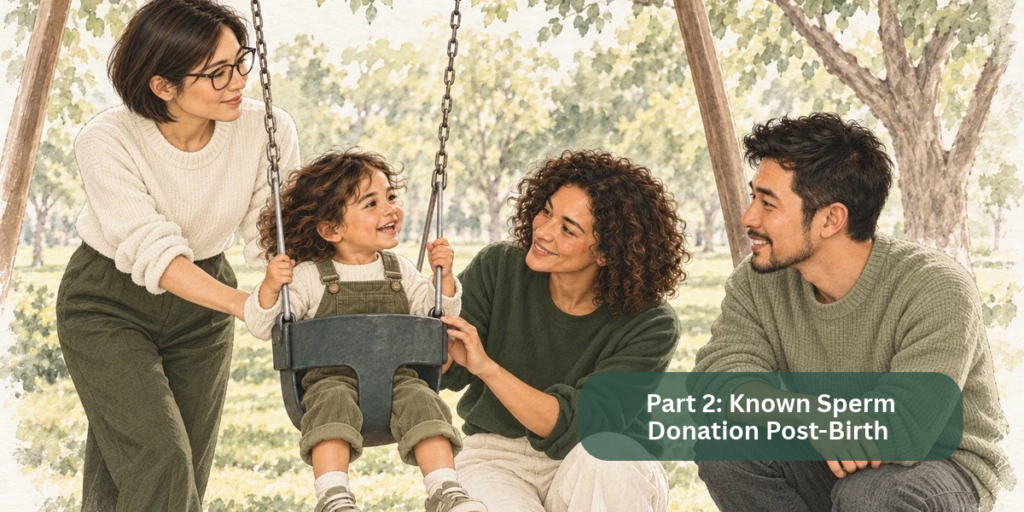
This is Part 2 of our two-part series about building your family with a known sperm donor in Ontario. If you are preparing for donation or conception, start with Part 1: Known Sperm Donation in Ontario – Legal Steps Before Conception.
Your baby has arrived. All the conversations, appointments, and paperwork led to this point – holding the child you hoped for.
You may also be discovering what your relationship with your known sperm donor looks like in everyday life.
Maybe visits are happening more often than you expected or your donor wants a say in decisions you understood would be yours. Or maybe everyone is getting along well and you simply want the status quo to remain as your child grows.
You can welcome your donor’s connection to your child and still be clear that you are the parent or parents.
Your sperm donation agreement is a good foundation. After birth, the work is in living by it.
At Flowerday Fertility Law, we help families understand how their original plans relate to changing circumstances, so questions get dealt with early, before they turn into disagreements.
1. When to Revisit Your Sperm Donor Agreement After Birth
Your sperm donation agreement should do more than occupy a digital folder.
Before conception, it helped you discuss intentions, contact, privacy, and responsibilities. After birth, it can help you remember what everyone agreed and identify when expectations are changing.
You might revisit it when:
- someone asks for a different level of contact;
- your donor’s partner or relatives become more involved;
- questions arise about holidays, photographs, or social media;
- your child begins asking about their donor;
- practical help starts developing into an ongoing caregiving role; and
- someone expects to participate in parenting decisions.
Treat the agreement as something you return to, not something you signed and forgot.
If a provision is unclear or no longer reflects what someone wants, obtain advice about the proposed change rather than assuming an informal understanding is enough.
Some families set a regular check-in, such as around the child’s birthday, to talk about how contact is going and whether anything needs adjusting. A planned conversation is easier than one that only happens when something has gone wrong.
2. Can a Sperm Donor Become a Legal Parent After Birth in Ontario?
A signed sperm donation agreement is important evidence of your intentions, but it is not a guarantee that later conduct will have no legal consequences.
Ontario law distinguishes between legal parentage, parenting or contact arrangements, and child support. Questions in one area do not necessarily have the same answer in another.
For example, Ontario’s Family Law Act includes within its definition of a parent someone who has demonstrated a settled intention to treat a child as a child of their family. Separately, Ontario’s Children’s Law Reform Act provides for applications concerning contact with a child by people other than parents. These provisions help explain why the relationship that develops after birth can matter, even where the original arrangement was sperm donation.
This does not mean a donor automatically becomes a legal parent by visiting, babysitting, or caring about your child. It means that significant changes in their role should be assessed in context.
An agreement cannot conclusively determine a child’s rights or require a court to disregard the child’s best interests. If the relationship begins to resemble parenting, seek advice before assuming the original agreement answers every question.
Worried your donor’s role is starting to look like parenting? Book a free consultation with Michelle Flowerday to talk through where you stand.
3. Donor Connection vs. Parenting Role: Where Is the Line?
Families approach known-donor relationships in different ways.
Some exchange occasional updates. Others enjoy visits or include the donor in family celebrations. A donor who is already a friend or relative may naturally remain part of your lives.
The question is how everyone understands and carries out their role.
Consider whether your donor is:
- spending time with your child within the relationship you planned;
- helping occasionally at your invitation;
- expecting an ongoing entitlement to time with your child;
- taking responsibility for raising your child;
- expecting authority over education, health care, discipline, or other major decisions; or
- presenting themselves to others as a parent.
These examples are prompts for discussion, not a legal checklist. No single visit, label, or act of kindness determines the outcome.
Look at the relationship as a whole: what people expect, what they do, and what your child experiences.
4. Signs Your Known Donor Boundaries Are Shifting
Changes often happen gradually and with good intentions.
An occasional afternoon visit becomes a weekly overnight stay. Help with an expense becomes regular financial support accompanied by an expectation of decision-making. A donor begins attending appointments and assumes they should help choose treatment.
The issue may only become visible when someone says no.
Imagine that you agreed your donor would receive updates and attend occasional family gatherings. Over time, they begin asking to approve childcare arrangements and describe themselves as having an equal say in how your child is raised.
That is a reason to pause and seek advice about the developing relationship. It is not a reason to assume that a particular legal outcome has already occurred.
Questions worth asking include:
- Is this consistent with the arrangement we intended?
- Does everyone understand who makes parenting decisions?
- Are we agreeing freely, or feeling pressured by gratitude or fear of conflict?
- Are expectations being communicated clearly?
- Would this change affect our child’s understanding of the relationship?
You can appreciate your donor’s generosity and still raise a concern about boundaries.
It can also help to keep simple notes of significant changes, such as when overnight visits started, when your donor began contributing money, or when they first asked to be involved in a decision. If you do need advice later, an accurate timeline gives your lawyer a much clearer picture than memory alone.
5. Setting Expectations With Your Donor’s Partner & Extended Family
A donor arrangement can involve more people than those who signed the agreement.
Your donor’s partner may have expectations about visits. Their parents may see themselves as grandparents. Your own relatives may use language that does not reflect the relationship you planned. It helps to talk this through before a birthday party or holiday forces the question.
Where appropriate, agree on:
- how the donor and their relatives will be introduced;
- what information may be shared about your child’s conception;
- who coordinates invitations and visits;
- what photographs or updates may be shared, including on social media; and
- how questions about the relationship will be answered.
You can be honest about your child’s genetic connections while explaining the family roles you have established. Using the same words each time helps avoid misunderstandings and gives your child a clearer story about the people in their life.
6. Talking With Your Donor-Conceived Child About Their Donor
Your child may experience their donor connection differently at different ages.
They may want to know more about their origins, meet people who share their genetic background, or ask questions that you and your donor did not anticipate before conception.
Many families find it easier to share the story early, in simple words that grow with the child, so that it never arrives as a surprise. Consumer DNA tests also mean donor-conceived people can find genetic relatives on their own, which is one more reason to be open from the start.
Boundaries are there to help you respond to your child, not to shut their questions down.
Listen without making your child responsible for managing the adults’ feelings. Their curiosity about their donor does not diminish your place in their life.
A counsellor experienced in donor conception can help you navigate these conversations. Legal advice can help where a proposed change goes beyond contact and starts to affect responsibilities or the structure of the arrangement.
Your agreement is still a useful starting point as your child’s needs change.
7. When to Call a Fertility Lawyer About Your Donor’s Role
Relationships change. What matters is recognizing when a change needs more than a casual conversation.
Contact your lawyer if, for example:
- your donor wants to become a co-parent;
- you are considering an ongoing shared-care arrangement;
- someone expects authority over major decisions;
- financial contributions are becoming part of a broader parenting arrangement;
- your donor asserts a right to contact or parenting involvement;
- a disagreement arises about the donor’s role; or
- a separation, relocation, or other major change affects the arrangement.
If a close relationship has already developed, obtain advice before abruptly changing contact. A sudden change can be hard on your child and it can also have legal implications.
Writing down a new understanding may be helpful, but it does not automatically resolve the legal consequences. Your lawyer can explain whether changes to documentation, counselling, or other steps are appropriate.
8. Using Your Plaid Fertility Law Agreement After Birth
A tailored agreement works best when everyone understands it and acts in line with what it was meant to do.
If your agreement was prepared through Plaid Fertility Law, return to the document when questions arise about the intentions and expectations you recorded.
Plaid is our custom-built web application for preparing tailored fertility agreements with legal advice and lawyer review central to the process. After signing, the agreement remains a reference point for your family.
When circumstances change, bring the question back to your lawyer. The signed document is the starting point for that discussion; it cannot assess a new situation on its own.
Implications counselling can also remain valuable after birth, particularly where you want help discussing boundaries while preserving an important friendship or family relationship.
FAQs About Known Sperm Donor Boundaries After Birth
Does regular contact automatically make a sperm donor a parent?
No. Regular contact alone does not automatically establish legal parentage. The nature of the relationship and the legal question involved matter. Seek advice if involvement is developing into a parenting role.
Can our donor babysit or attend birthdays?
These activities do not, by themselves, determine legal status. Discuss them within the context of your agreement, your expectations, and the wider relationship. There is no universal number of visits or hours that answers the legal question.
Does our agreement prevent every future claim?
No agreement can guarantee that nobody will bring a claim or that every future dispute will have a particular outcome. A carefully prepared agreement remains important, but later conduct and the applicable law may also matter.
What if everyone agrees the donor should become more involved?
Obtain advice before implementing a significant change. Everyone’s agreement is important, but it does not replace an assessment of the legal consequences or your child’s interests.
What if the donor wants a parenting role that we never agreed to?
Seek advice promptly. Review the original agreement and the relationship that has developed. Your lawyer can help you understand your position and consider appropriate ways to address the disagreement.
Should we revisit the agreement even if we have no concerns?
Yes, when a relevant question or change arises. Clear, respectful conversations can help everyone recognize different expectations before they become a source of conflict.
Get Advice on Your Known Donor Arrangement in Ontario
You chose a known donor with hopes for your child and the family you wanted to build. Staying clear about roles after birth helps you keep those intentions in place as your child grows.
The agreement sets the direction. How you talk and act day to day is what makes it work.
If boundaries are becoming unclear, or you are considering a change in your donor’s role, Flowerday Fertility Law can help you understand the legal questions and your next steps.
Contact Flowerday Fertility Law for advice about your known-donor arrangement. If you are still preparing for conception, start with Part 1 and explore Plaid Fertility Law to begin your tailored sperm donation agreement.
This article provides general information about known sperm donor relationships in Ontario and is not legal advice. The consequences of a particular arrangement depend on the facts, applicable law, and any other jurisdictions involved.