
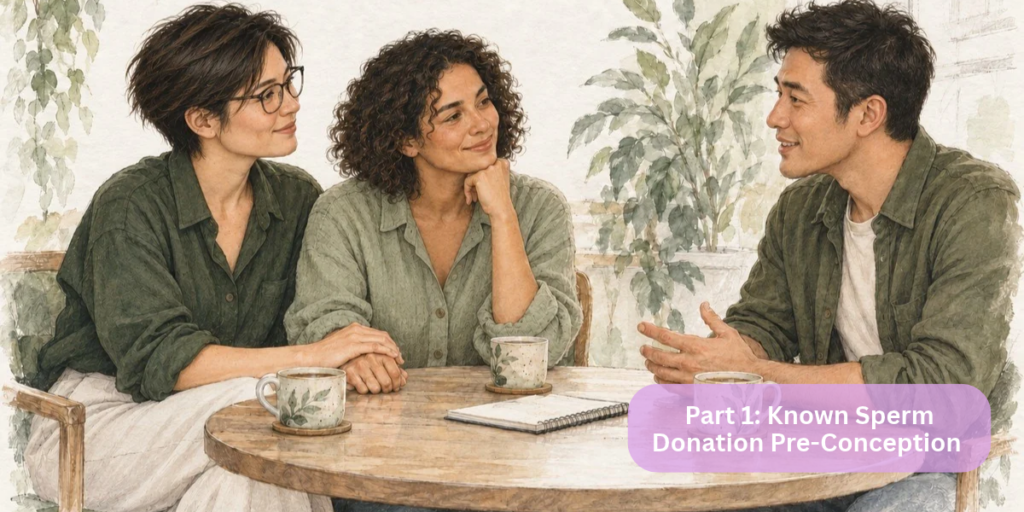
This is Part 1 of our two-part series about building your family with a known sperm donor in Ontario. Here, we explore the steps before conception. In Part 2, we discuss boundaries after birth and why your sperm donation agreement still matters.
Perhaps a close friend has offered to help you become a parent. Perhaps you and your partner are considering a family member as your donor. Or perhaps you have connected with someone who shares your hopes for a thoughtful, open donor relationship.
Choosing a known sperm donor can make your path to parenthood feel more personal. It can also bring questions that are difficult to raise with someone you know and care about.
Will your donor have a relationship with your child? How will you explain everyone’s roles? What happens if expectations change? And what steps will establish you as your child’s legal parent or parents?
Some of these questions have legal answers. Others are for you and your donor to work out together, ideally before anyone tries to conceive.
At Flowerday Fertility Law, we help you work through these questions before conception. With early advice, honest conversations, and a tailored sperm donation agreement, you can move forward knowing where everyone stands.
1. Speak With a Fertility Lawyer Before Choosing a Known Donor
Before arranging a donation or attempting conception, speak with a fertility lawyer about your plans. You don’t need to have every detail decided. An early consultation can help you identify what to discuss with your donor and understand which legal steps apply.
Be ready to explain:
- who intends to be the child’s parent or parents;
- who your donor is and where everyone lives;
- whether you plan to conceive at home or through a fertility clinic;
- what relationship you hope your donor will have with your child; and
- whether this same donor will help you conceive future children.
These details help shape your legal plan.
If you intend your donor to share parenting responsibilities, raise that at the outset. A co-parenting arrangement requires different advice from an arrangement in which the donor will not be a parent.
Start with the family you want to build. Your lawyer can map the legal steps from there.
Book A Free Consultation with Michelle Flowerday
2. Does a Known Sperm Donor Have Parental Rights in Ontario?
A genetic connection and legal parentage are different questions.
Under Ontario’s Children’s Law Reform Act (“CLRA”), providing sperm for assisted reproduction does not, by itself, make someone a legal parent. The CLRA also establishes pathways through which intended parents may be legally recognized.
Your legal advice should therefore address both:
- your donor’s intended role; and
- the legal basis on which each intended parent will be recognized.
A sperm donation agreement records important intentions and responsibilities. However, it does not override the law or automatically resolve every parentage issue. Ask your lawyer whether your circumstances call for a donor agreement, a separate pre-conception parentage agreement, or additional legal steps.
Not sure how Ontario’s parentage rules apply to your family? Book a free consultation with Michelle Flowerday before you finalize anything with your donor.
3. Agree on Contact & Boundaries With Your Known Donor
Knowing your donor can offer a meaningful connection to your child’s origins. It can also make it easy to assume that everyone understands the arrangement in the same way.
You might imagine occasional updates while your donor imagines regular visits. You might expect to tell your child about their donor from an early age, while your donor has not considered what their own family will be told.
Before proceeding, discuss:
- The donor’s role: How will you describe their connection to your child?
- Names: What will your child call your donor and how will the donor’s own children refer to your child?
- Future contact: Do you anticipate updates, visits, birthdays, or holidays together?
- Extended family: What involvement might the donor’s partner, parents, or children have?
- Privacy: Who may know about the arrangement and what may be shared online?
- Health information: How will you exchange important medical and family health updates?
- Changing expectations: How will you approach requests for more or less contact over time?
Consider your future child’s perspective, too. Their questions and wishes may evolve as they grow.
No agreement can predict every situation. What matters is knowing where you each stand now and agreeing on how you will talk about it when something changes.
Conception with a Friend or Family Member as Your Sperm Donor
An existing relationship can provide trust and familiarity, but it can also make sensitive conversations harder.
For example, a relative donating to help create a genetic connection within your family may already have an established role as an uncle or another family member. Discuss how you will explain the donation and manage expectations within that existing relationship.
Obtain medical advice about the suitability of any proposed donation, including relevant genetic relationships.
Taking time over these conversations now helps protect the relationship you already have with your donor.
4. Book Implications Counselling for You & Your Donor
Choosing a known donor involves emotional and relationship decisions alongside the medical and legal steps. Implications counselling gives you and your donor space to explore what the arrangement may mean for your lives, your existing families, and your future child.
A counsellor experienced in donor conception can help you discuss:
- how you will talk to your child about their origins;
- expectations for the donor’s involvement;
- the effect on partners and other children;
- boundaries within friendships or family relationships; and
- how feelings and circumstances may change over time.
Counselling often brings up questions you had not thought to ask, which is part of its value.
Read more about implications counselling before surrogacy and donation.
5. Home Insemination vs. Fertility Clinic: Legal Differences in Ontario
If you are considering home insemination, you may wonder whether you still need legal advice.
Conceiving at home does not remove the need to understand parentage, consent, and your donor’s role.
For Ontario parentage law, the method of conception matters. Assisted reproduction means conception by a method other than sexual intercourse. Home insemination and conception through sexual intercourse should therefore not be treated as interchangeable arrangements.
Ontario has a specific exception concerning conception through sexual intercourse where the sperm provider and intended birth parent agree in writing, before conception, that the sperm provider does not intend to be a parent. Obtain legal advice before relying on that exception.
If you are working with a fertility clinic, ask about its known-donor screening, counselling, consent, and legal-clearance requirements before scheduling treatment.
If you use a fertility clinic, your donor will go through medical screening and testing under federal safety rules before the sperm can be used. Ask the clinic how long this takes so you can plan around it.
Your legal agreement does not replace medical screening or professional advice about the health considerations of your chosen approach.
6. What to Include in a Known Sperm Donor Agreement in Ontario
You may be wondering: “We trust our donor. Why do we need an agreement?”
Trust is a strong starting point. A written agreement turns that trust into clear expectations you can both refer back to.
Preparing a known sperm donor agreement in Ontario gives you an opportunity to discuss important questions before pregnancy, when everyone has time to reflect and obtain advice.
Your agreement can address:
- the intentions of the donor and intended parent or parents;
- the planned method of conception;
- consent and proposed uses of donated sperm;
- storage and possible use for future siblings;
- medical information and ongoing health updates;
- expectations about contact and communication;
- privacy and disclosure;
- eligible expense reimbursement;
- what happens if plans change before conception; and
- how disagreements will be approached.
A fertility lawyer can be a valuable starting point when you’re considering sperm donation, helping you understand the available pathways and determine which approach best aligns with your family-building goals. Whether you’re working with a fertility clinic, considering a known donor, or exploring other arrangements, seeking legal guidance early can help you navigate potential challenges and make informed decisions before moving forward.
If you’re working with a clinic, your donor will also sign consent forms explaining how consent is given and when and how consent can be withdrawn. It’s important that these forms align with your donor agreement, particularly if you plan to store sperm for future siblings.
Your lawyer can help clarify which provisions document expectations, which carry legal weight, and where the law places limits on what an agreement can achieve.
Your donor should also have their own lawyer for independent legal advice before signing. This ensures everyone has the opportunity to ask questions, understand their rights and responsibilities, and move forward with clarity and confidence.
Create Your Known Sperm Donor Agreement Online With Plaid Fertility Law
You have made thoughtful decisions about your donor and the family you hope to build. Plaid Fertility Law, our custom-built web application, helps you turn those decisions into a tailored sperm donation agreement, with legal guidance throughout.
Through guided prompts, you can provide the details of your arrangement at your own pace. We then review your agreement together, answer your questions, and make any necessary revisions before your donor’s lawyer completes their independent legal review.
Plaid keeps preparation, lawyer review, and signing in one place, so you can move forward quickly with an agreement that reflects your family.
7. Can You Pay a Sperm Donor in Canada? Reimbursement Rules
When someone is helping you build your family, you may understandably want to recognize their generosity.
Canadian law prohibits purchasing sperm from a donor or someone acting on their behalf. Eligible donation-related expenses may be reimbursed in accordance with federal requirements.
In practice, that means a receipt for each expense, such as travel, parking, counselling, net lost wages, or legal fees, plus a signed declaration from your donor listing each one. Mileage is calculated at the Canada Revenue Agency’s automobile allowance rate instead of by receipt. Keep these records for six years.
Discuss proposed payments with your lawyer before making commitments. Your agreement should explain how permitted reimbursements will be handled and what documentation is needed.
Do not assume that a payment is permitted simply because everyone agrees to it or describes it as a gift.
8. Sign Your Sperm Donor Agreement Before Conception
Give yourselves time to discuss the arrangement, obtain independent advice, and finalize the necessary documents before attempting conception.
Where a fertility clinic is involved, coordinate timing with its team so that legal requirements do not become a last-minute obstacle.
Before moving forward, confirm that:
- your agreement has been reviewed and signed;
- everyone has received appropriate legal advice;
- relevant medical and counselling requirements have been addressed;
- you understand how each intended parent’s legal parentage will be established; and
- you know what documentation or registration steps may follow birth.
If conception has already occurred, seek advice promptly. A later agreement should not be assumed to have the same effect as one completed before conception. Your lawyer can explain your current position and available options.
Why Your Sperm Donor Agreement Still Matters After Birth
Completing your sperm donation agreement is an important milestone. It should then guide how you approach the relationship after your child is born.
If your donor’s involvement gradually develops into a parenting role, questions about contact, responsibilities, or support may arise. A signed agreement remains important, but it cannot guarantee how a future dispute would be resolved, especially if the relationship has come to look different from what the agreement describes.
That does not mean your donor cannot have a meaningful relationship with your child. It means the relationship deserves ongoing attention, clear expectations, and advice before it evolves significantly.
Continue to Part 2: Known Sperm Donor Boundaries After Birth – Why Your Agreement Still Matters.
FAQs About Known Sperm Donation in Ontario
Can a friend be my sperm donor?
Yes. A friend may be a known sperm donor, subject to the medical and legal requirements applicable to your arrangement. Discuss their intended role, future contact, and boundaries before proceeding.
Can a family member be our sperm donor?
A family member may be an option in an appropriate arrangement. Obtain medical advice about genetic relationships and screening, as well as legal advice about parentage and family expectations.
Can our donor have a relationship with our child?
A known-donor arrangement can include expectations for contact. Discuss the relationship you hope to have, how you will explain it to your child, and how donor involvement will be distinguished from parenting responsibilities. Part 2 of this series explores this in more detail.
Does a sperm donor agreement automatically make both intended parents the legal parents?
No. Your lawyer must assess how Ontario’s parentage rules apply to each intended parent. Depending on your circumstances, additional agreements or legal steps may be appropriate.
Can we use an online sperm donor agreement template?
No. A general template may overlook important details about your family, method of conception, consent, or parentage. Plaid Fertility Law helps you prepare a tailored agreement with legal advice and lawyer review built into the process.
When should we sign our known sperm donor agreement?
Arrange legal advice early and complete your agreement before attempting conception. If you are working with a fertility clinic, confirm its requirements and timeline before arranging donation or treatment.
Talk to an Ontario Fertility Lawyer About Known Sperm Donation
You want to welcome a child while treating the people helping you with care and respect. Clear expectations and early legal planning can help you move towards that future with greater confidence.
Addressing questions about contact, boundaries, and responsibilities now lets everyone go into the arrangement with clear eyes.
At Flowerday Fertility Law, we help you understand your options, prepare your sperm donation agreement, and identify the parentage steps that apply to your family.
Get started with Plaid Fertility Law, or contact Flowerday Fertility Law to book an introductory consultation before donation or conception.
When you are ready, we are here to help you take the next step.
This article provides general information about known sperm donation in Ontario and is not legal advice. Your legal requirements depend on your circumstances and any other jurisdictions involved.